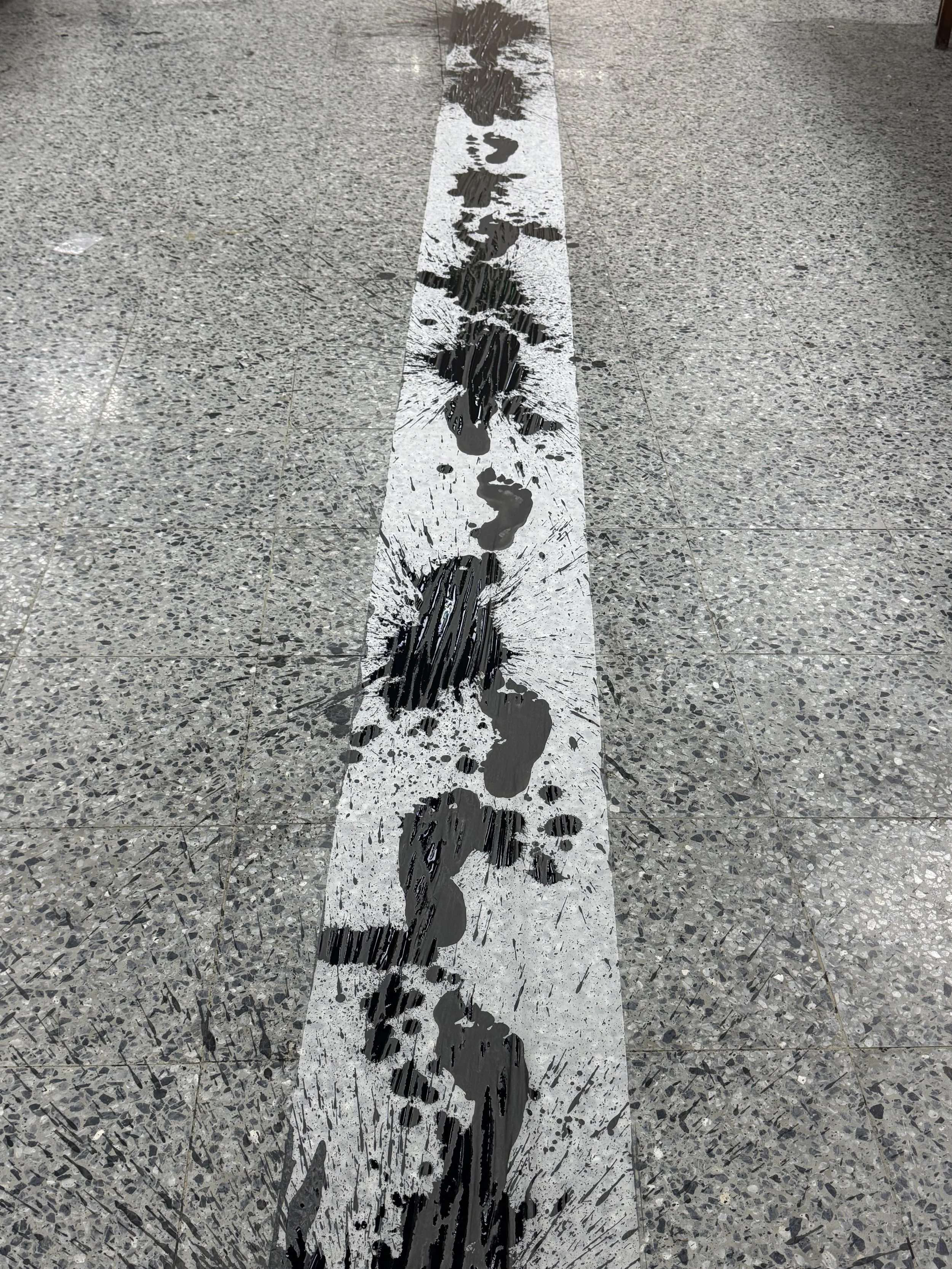
Walking Calligraphy
Paper, Ink, Bowl, Jugs
Taiwanese Imagery Calligraphy Museum
Baihe.Taiwan
2026
Part of Live Art Festival - Myriad Images curated by Cai Qing
Performance documentation by Cai Qing , ShihMin and Li-Ping Ting
Responding to the architecture of the Calligraphy Artist Studio at the Taiwanese Imagery Calligraphy Museum, this performance explores the interaction between space, activity, and artwork, and the role of calligraphy as a lived, witnessed event. It considers how the studio’s physical layout frames movements and how viewers become part of the work through their presence and attention during the live execution.
Central to the piece is the body as the origin of every stroke. Traditional calligraphy is understood here as a continuity of internal energy: the artist’s intention travels from mind to body, through the arm and wrist, into the brush, and finally to the paper. Each mark is an imprint of that transmission. In this performance I deliberately foreground that embodied process by making my current physical and mental state visible. The work takes the condition of “Overflowing” as both concept and method. A heavy bowl holding four liters of black ink becomes a literal and symbolic weight: its mass burdens my arms and governs my steps. Walking slowly across the paper while carrying the bowl, each step is measured and strained; the ink’s excess spills, drips, and flows, recording the slowing, the effort, and the instability of containment. The resulting marks function as a trace of an attempt to hold in and make legible an abundance of thought and feeling. The spills and brush-like gestures are equal parts calligraphic stroke and index of bodily labor — evidence that meaning is produced not only by intentional line but by the physical limits and failures of containment.
The performance asserts that calligraphy is not only visual language but a somatic event: the studio architecture, the audience’s witnessing, the movement of the artist, and the material behavior of ink together create a field where internal states become external inscriptions. The audience witnesses both the making and the unreadable overflow, invited to read the work as a record of embodied energy and the struggle to contain and express an excess of thought.